Home Page Stories
Jan 27, 2026

Big retailers are committing more heavily to agentic AI-led commerce, and accepting some loss of customer proximity and data control in the process.

As reported by Retail Dive, the opening weeks of 2026 have seen Etsy, Target and Walmart push product ranges onto third-party AI platforms, forming new partnerships with Google’s Gemini and Microsoft’s Copilot, after last year’s collaborations with OpenAI’s ChatGPT. These let consumers purchase goods inside the AI’s conversation interface.

Amazon and Walmart have been investing in their own consumer-facing AI assistants, Rufus and Sparky respectively to change how shoppers interact with their brands.

Agentic AI is beginning to redraw direct-to-consumer engagement, and industry figures regard this trend as an important moment in online retail. “I think this has the potential to disrupt retail in the same way the internet once did,” Kartik Hosanagar, a marketing professor at the Wharton School of the University of Pennsylvania, told the website’s reporters.

Partnering with AIs like ChatGPT or Gemini engages consumers wherever they happen to be and may choose to shop. Adobe’s 2025 Holiday Shopping report found that AI-driven traffic to US e-commerce sites grew 758% year on year between in November 2025, and Cyber Monday saw a 670% increase in AI-referred retail visits.

“What we expect is a deepening of consumer engagement,” Katherine Black, a partner at Kearney specialising in food, drug and mass-market retail, said in an email to Retail Dive. “More shoppers will rely on AI for purchasing, and across a wider range of missions. As retailers’ capabilities within these tools improve, adoption should accelerate further.”

Meeting customers on AI platforms comes with trade-offs, according to industry observers, with questions around data ownership and the risk that retailers are sidelined. 81% of retail executives believe generative AI will erode brand loyalty by 2027, according to Deloitte’s 2026 Retail Industry Global Outlook, published earlier this month.

Retailers’ websites or apps provide a stream of behavioural data, and if discovery, evaluation, and purchase happen externally, any insight doesn’t reach the retailer. “This fundamentally changes where power sits,” Hosanagar said. “Control over the agent increasingly means control over the customer relationship.”


Page News

The history of Canada covers the period from the arrival of Paleo-Indians thousands of years ago to the present day. Prior to European colonization, the lands encompassing present-day Canada were inhabited for millennia by Aboriginal peoples, with distinct trade networks, spiritual beliefs, and styles of social organization. Some of these civilizations had long faded by the time of the first European arrivals and have been discovered through archaeological investigations.

Canada's geography is divided into administrative divisions known as provinces and territories that are responsible for delivery of sub-national governance. When Canada was formed in 1867, three provinces of British North America — New Brunswick, Nova Scotia and the Province of Canada (which, on the formation of Canada, was divided into Ontario and Quebec) — were united to form a federated colony, which eventually became a sovereign nation in the next century. Over its history, Canada's international borders have changed several times, and the country has grown from the original four provinces to the current ten provinces and three territories. The ten provinces are Alberta, British Columbia, Manitoba, New Brunswick, Newfoundland and Labrador, Nova Scotia, Ontario, Prince Edward Island, Quebec, and Saskatchewan. Several of the provinces were former British colonies, Quebec was originally a French colony, while others were added as Canada grew. The three territories are Northwest Territories, Nunavut, and Yukon, which govern the rest of the area of the former British North America. Together, the provinces and territories make up the world's second-largest country by area.


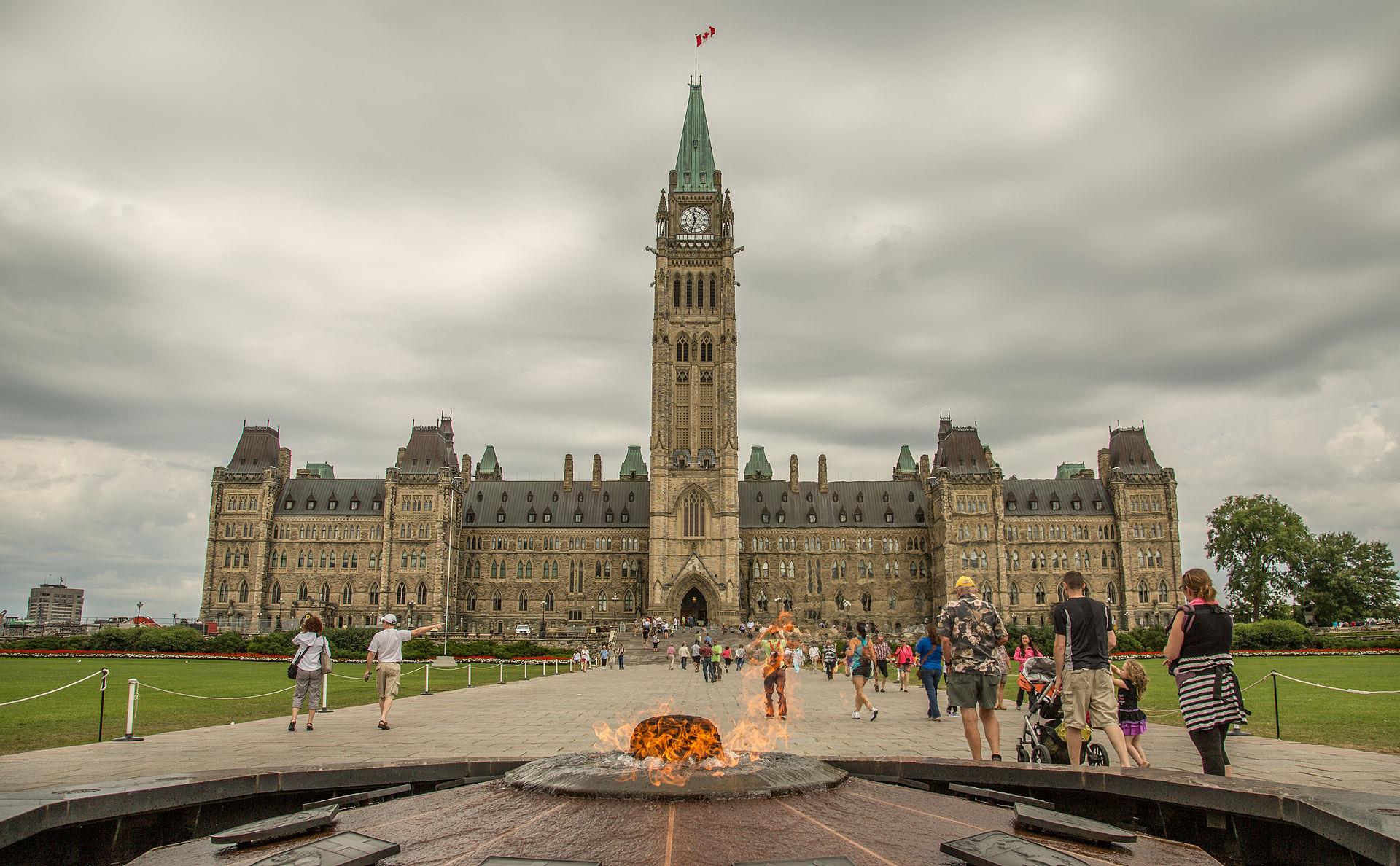
Welcome to Ottawa

Ottawa (/ˈɒtəwə/ (About this sound listen) or /-wɑː/; French pronunciation: ​[ɔtawa]) is the capital city of Canada. It stands on the south bank of the Ottawa River in the eastern portion of southern Ontario. Ottawa borders Gatineau, Quebec; the two form the core of the Ottawa–Gatineau census metropolitan area (CMA) and the National Capital Region (NCR).[10] As of 2016 Ottawa had a city population of 934,243 and a metropolitan population of 1,323,783 making it the fourth-largest city and the fifth-largest CMA in Canada.

Founded in 1826 as Bytown, and incorporated as "Ottawa" in 1855, the city has evolved into the political and technological centre of Canada. Its original boundaries were expanded through numerous annexations and were ultimately replaced by a new city incorporation and amalgamation in 2001 which significantly increased its land area. The city name "Ottawa" was chosen in reference to the Ottawa River, the name of which is derived from the Algonquin Odawa, meaning "to trade".[11]


November 2026

S
M
T
W
T
F
S
01 02
03
04
05
06
07
08
09
10
11
12
13
14
15
16
17
18
19
20
21
22
23
24
25
26
27
28
My Speakers
General
Jul 31, 2026